

Past activities
« previous | page 4 of 7 | next »Bonn-Cologne Number Theory and Physics Meeting
The intention of the meeting was to bring together theoretical physicists and mathematicians working on the overlap of number theory and theoretical physics.
Confirmed speakers included Thomas Creutzig (Darmstadt), Martin Möller (Frankfurt) and Tobias Mühlenbruch (Hagen). The schedule can be found here.
Bethe Colloquium by Prof. Rocky Kolb
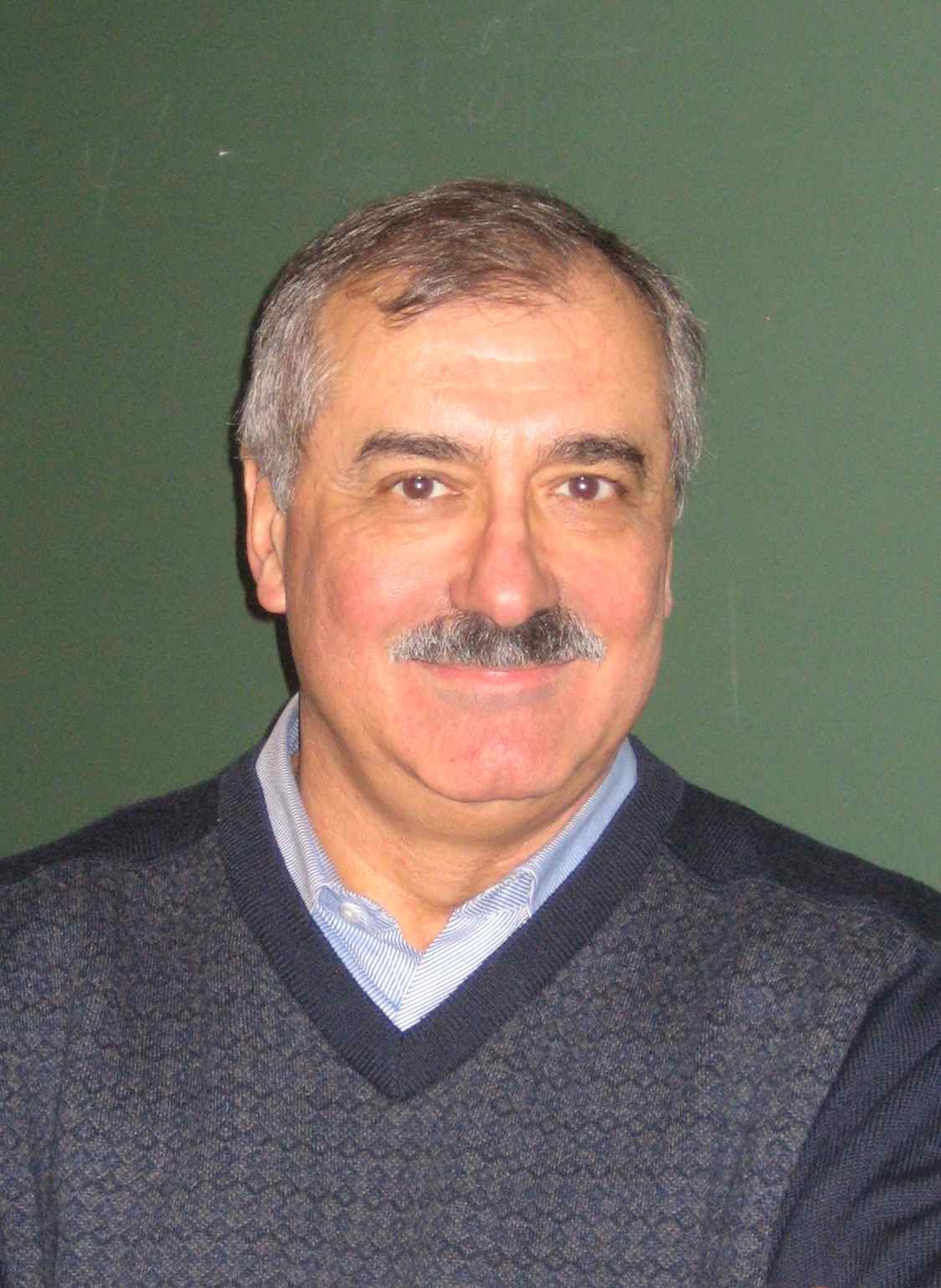
December's Bethe Colloquium took place on December 06 (3:15 pm) in Hörsaal I:
- Rocky Kolb (University of Chicago)
- Dark Matter Universe: On the Threshold of Discovery
- Hörsaal I, Physikalisches Institut
Abstract: Astronomical evidence, accumulated over eight decades, implies that most of the mass of the present universe is in the form of a new type of matter, referred to as "dark matter." The most promising explanation for dark matter is that it is in the form of a new species of elementary particle: a weakly interacting massive particle, or WIMP. In the lecture I will present the status of the WIMP conjecture and propose that we are on the threshold of testing the WIMP hypothesis.
Bethe Colloquium by Prof. Ulrich Ellwanger
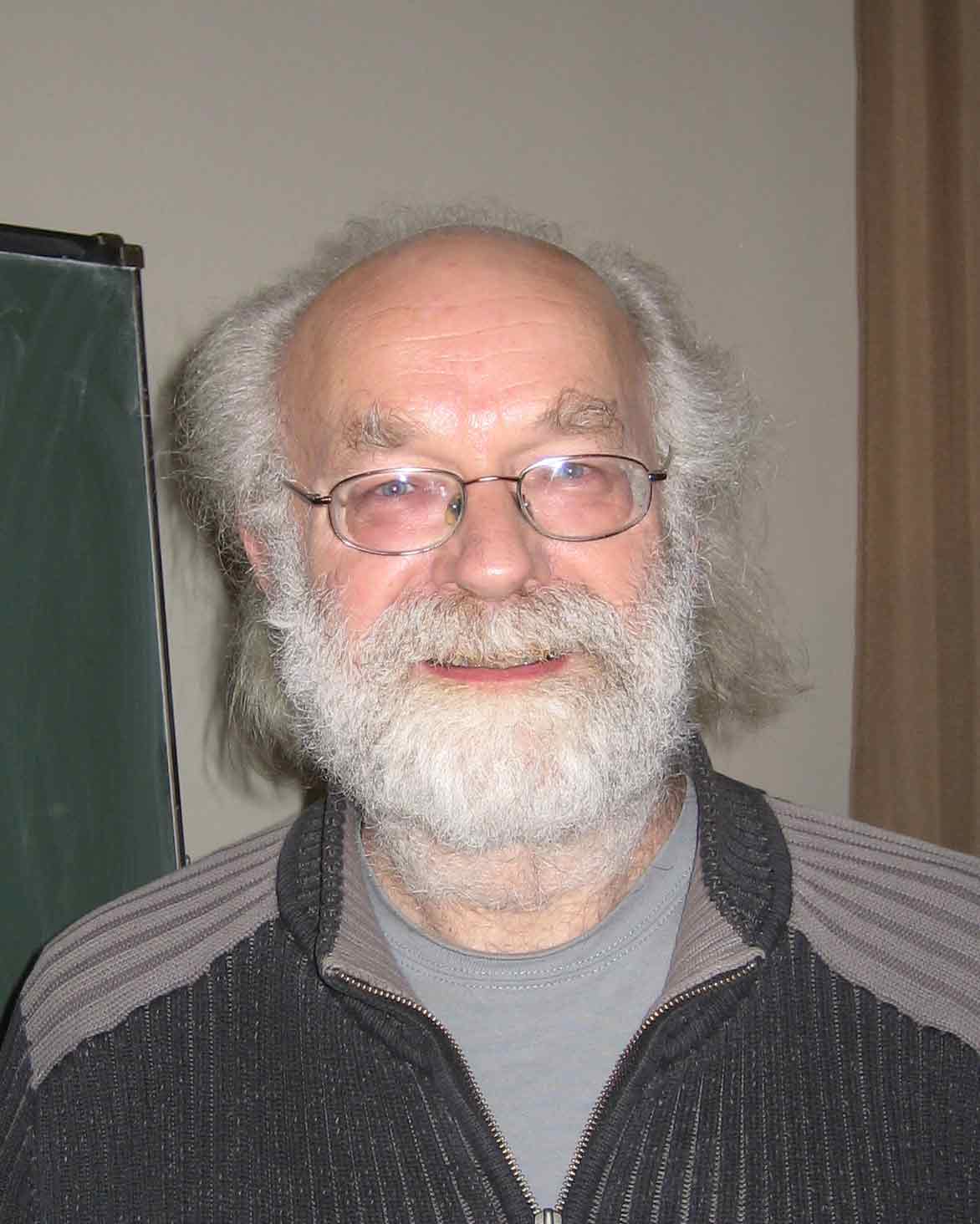
November's Bethe Colloquium took place on November 15 (3:15 pm) in Hörsaal I:
- Ulrich Ellwanger (Université Paris-Sud)
- The Higgs Boson
- Hörsaal I, Physikalisches Institut
Abstract: First, the reason for the existence of a Higgs boson will be explained in simple terms. Its production mechanisms and detection methods at particle accelerators will be reviewed, and confronted with recent results at the Large Hadron Collider. Finally I discuss what we can learn from precision measurements of the properties of the Higgs boson.
Bethe Forum on Unification and String Theory

- Global Model Building with a bias towards the Heterotic String
- Local Model Building focusing on constructions in the context of type IIB/F-theory
The homepage of the program can be found here.
Prejudice meets reality: Workshop and school on limit setting and global fits in the LHC era
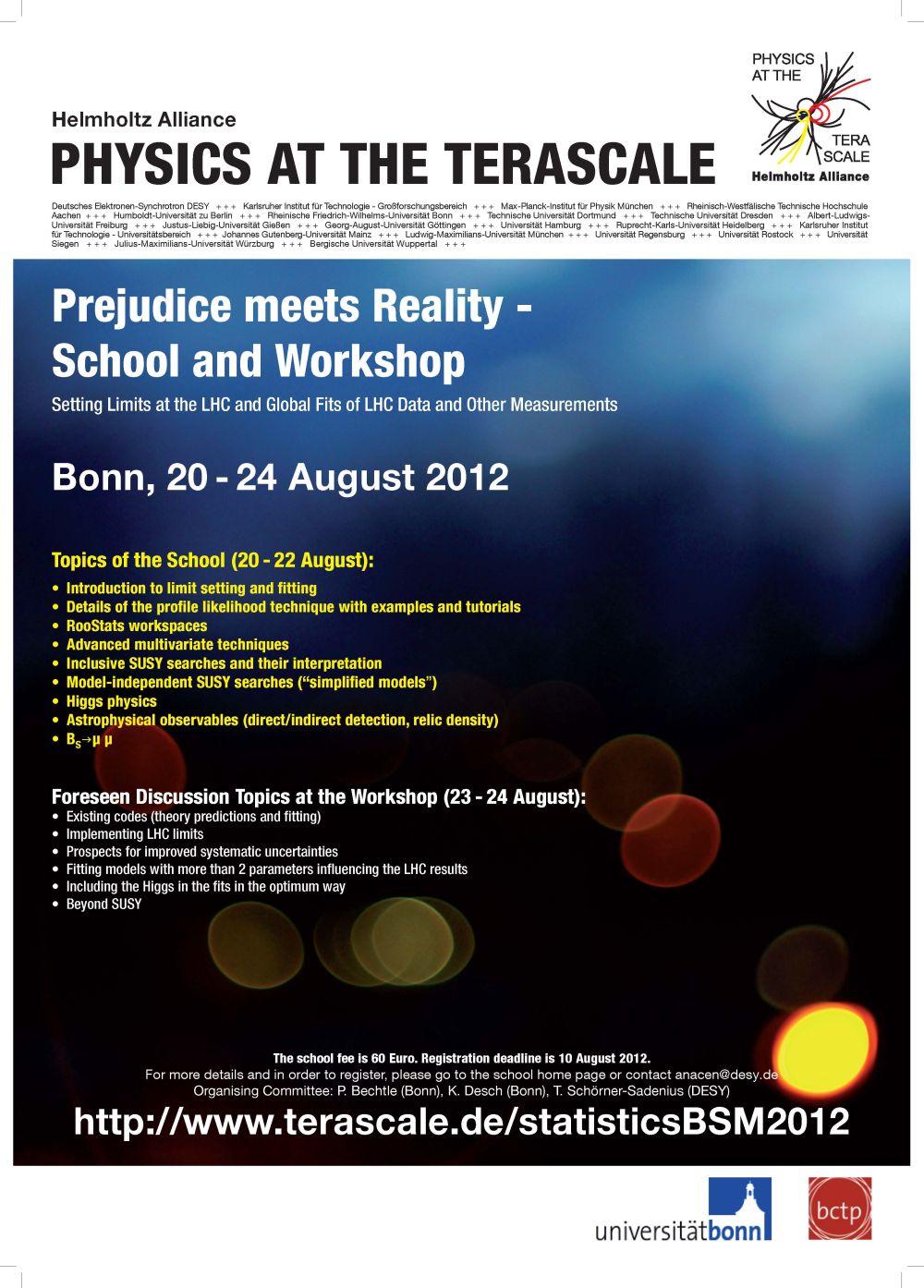
The homepage of the program can be found here.
String Math 2012
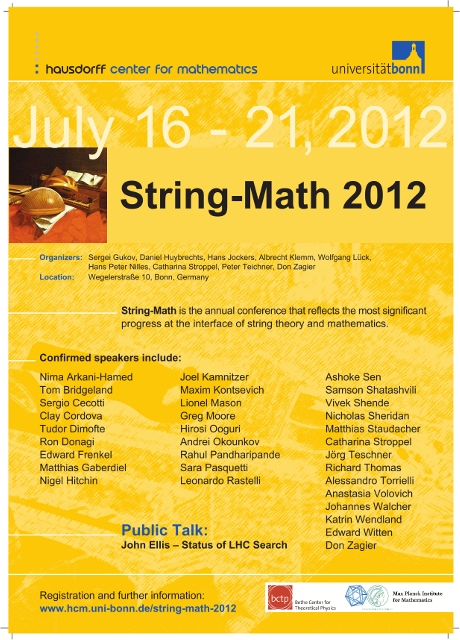
Lecture Series on Mathematical String Theory

The homepage of the program can be found here.
Bethe Colloquium by Prof. Erik Verlinde
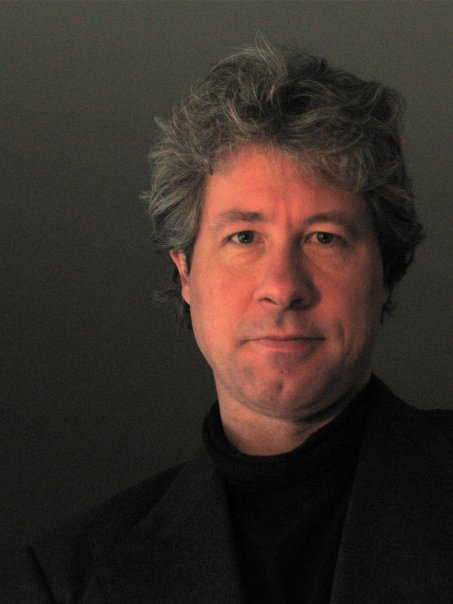
June's Bethe Colloquium took place on June 28 (3:15 pm) in Hörsaal I:
- Erik Verlinde (University of Amsterdam)
- Dark Matter, Dark Energy and the Emergence of Gravity
- Hörsaal I, Physikalisches Institut
Abstract: Insights from black hole physics and string theory strongly suggest that gravity is an emergent phenomenon and can be derived from an underlying microscopic description. The analogy between the gravitational field equations near black holes and thermodynamics and the known gauge/gravity dualities in string theory give particularly important clues towards the microscopic mechanism behind the emergence of gravity. Motivated by these ideas and by our best current understanding of M-theory, I propose a microscopic framework that naturally explains the origin of gravity, without presuming its presence. In this framework gravity, or rather inertia, arises as an adiabatic reaction force caused by fact that the microscopic phase space volume is influenced by the positions of matter. In a cosmological setting we find that that these ideas naturally give rise to the presence of dark energy, and furthermore lead to a quantitative match with the observed phenomena associated with dark matter, such as the flattening of rotation curves in spiral galaxies.
Bethe Colloquium by Prof. Michael Duff
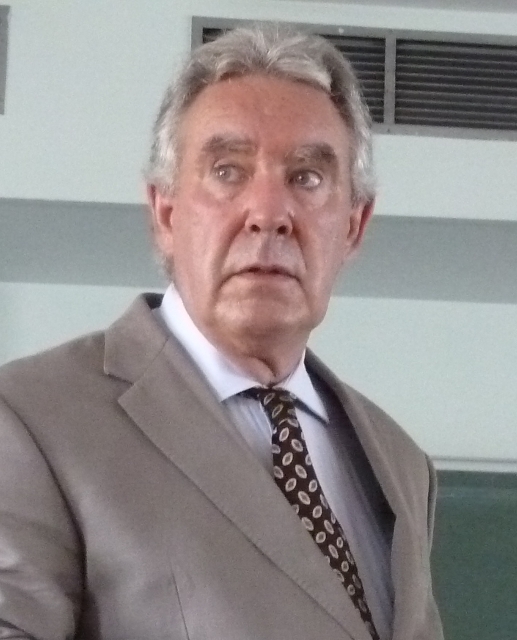
May's Bethe Colloquium took place on May 24 (3:15 pm) in Hörsaal I:
- Michael Duff (Imperial College London)
- Black holes and qubits
- Hörsaal I, Physikalisches Institut
Abstract: Two different branches of theoretical physics, string theory and quantum information theory (QIT), share many of the same features, allowing knowledge on one side to provide new insights on the other. In particular the matching of the classification of stringy black holes and the classification of four-qubit entanglement provides a falsifiable prediction in the field of QIT.
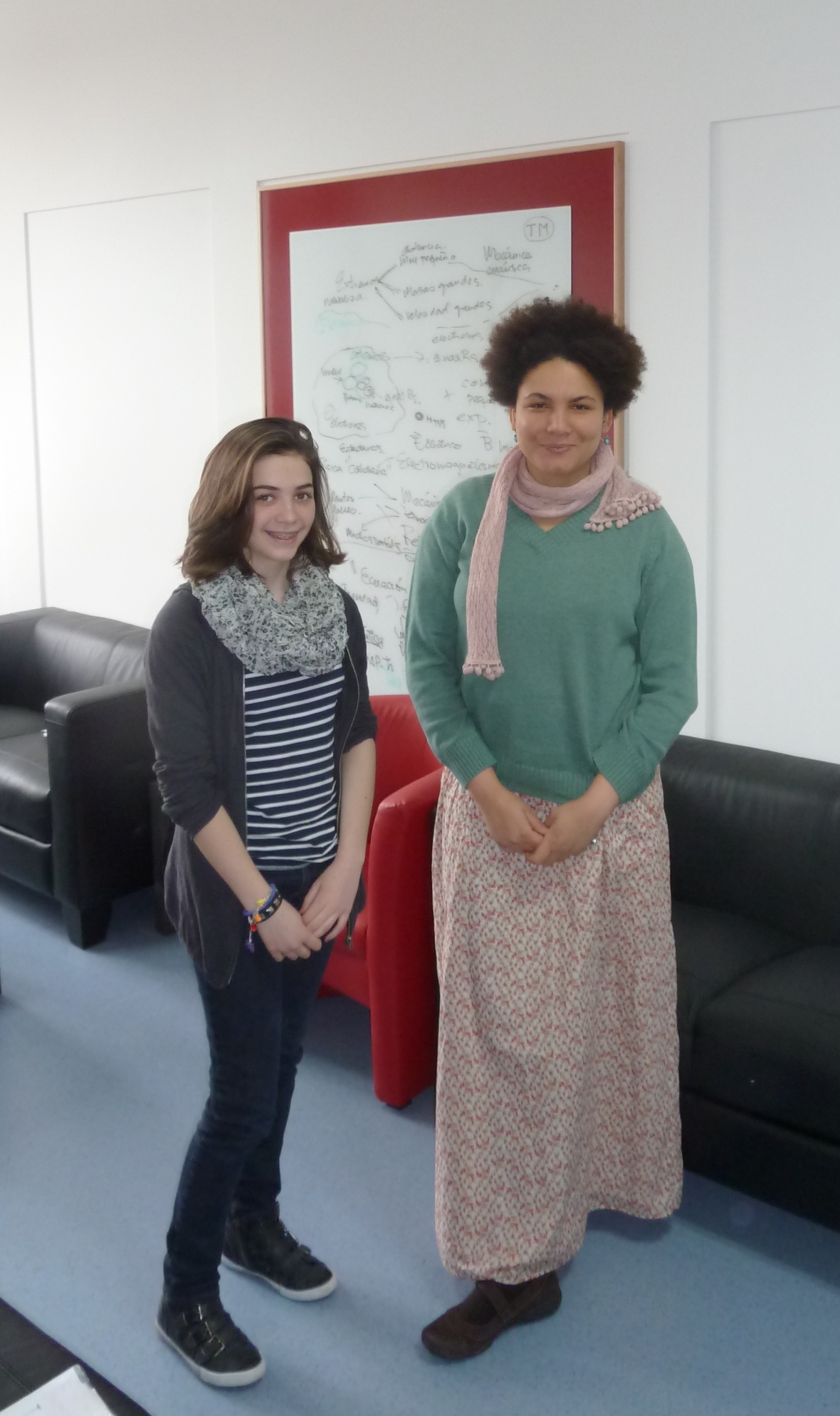
Girls' Day Visitor
Program on Exotic Hadrons
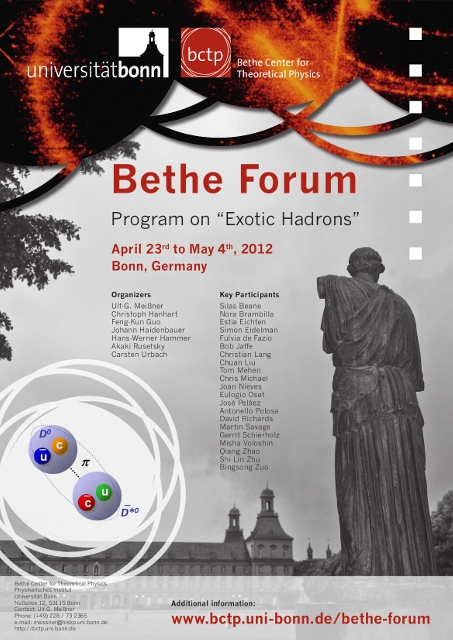
- Charmonia and exotica (decays, transitions, ...)
- Theory of multiquark states
- Theory of hadronic molecules
- Hadron resonances in Lattice QCD
.
Bethe Colloquium by Prof. Andy Lütken
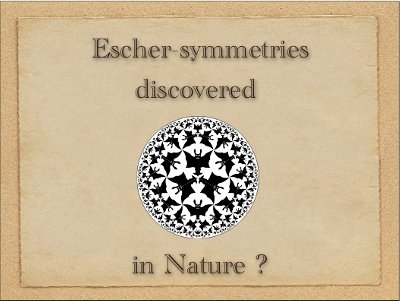
April's Bethe Colloquium took place on April 12 (3:15 pm) in Hörsaal I:
- Carsten Andrew Lütken (University of Oslo)
- Escher-symmetries discovered in Nature?
- Hörsaal I, Physikalisches Institut
Abstract: Two decades ago Graham Ross (Oxford University) and the speaker proposed that all universal data in quantum Hall systems is encoded in a family of emergent modular symmetries of the low energy effective field theory. This bold conjecture is reviewed, and shown to be in excellent agreement with a new generation of experiments. These are so cold that thermal fluctuations appear to be swamped by quantum fluctuations, rendering the emergent symmetry essentially exact. The symmetry predicts quantization of the transport coefficients, as well as the location of all quantum critical points, at certain rational points in the conductivity plane. The best experiments to date agree at the per trillion level for the Hall quantization, and at the per mille level for critical points.
Bethe Forum discussions with Kyriakos Papadodimas
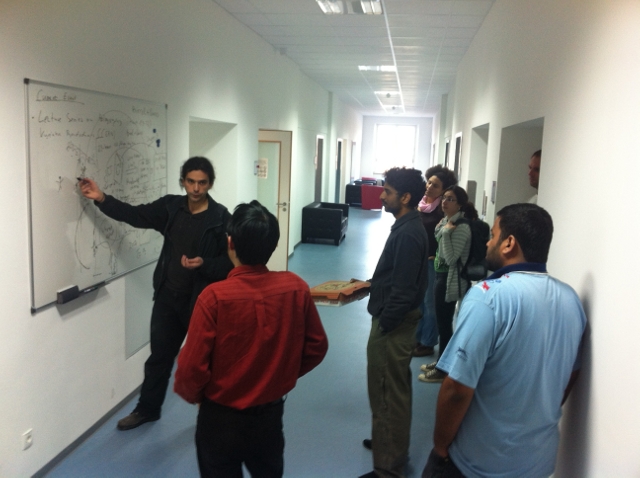
Bethe Forum: Lecture series on Holography and Physics at Strong Coupling (Kyriakos Papadodimas)
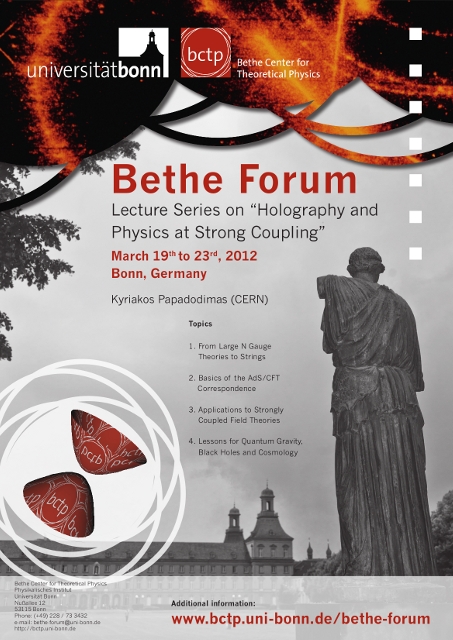
- From Large N Gauge Theories to Strings
- Basics of the AdS/CFT Correspondence
- Applications to Strongly Coupled Field Theories
- Lessons for Quantum Gravity, Black Holes and Cosmology
XXIV Workshop - Beyond the Standard Model
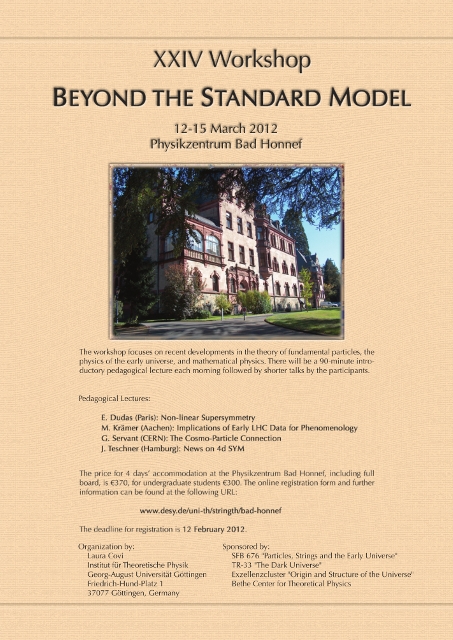
The topics and speakers of the pedagogical lectures were:
- E. Dudas (Paris): Non-linear supersymmetry
- M. Krämer (Aachen): Implications of early LHC data for phenomenology
- G. Servant (CERN): The cosmo-particle connection
- J. Teschner (Hamburg): News on 4d SYM
Workshop on the AGT Conjecture
The workshop′s intention was to bring together experts in two-dimensional conformal field theory and four-dimensional supersymmetric Yang-Mills theories to discuss the overlap of the two fields as suggested by AGT.
The homepage of the program can be found here.
The Chancellor visits the new rooms
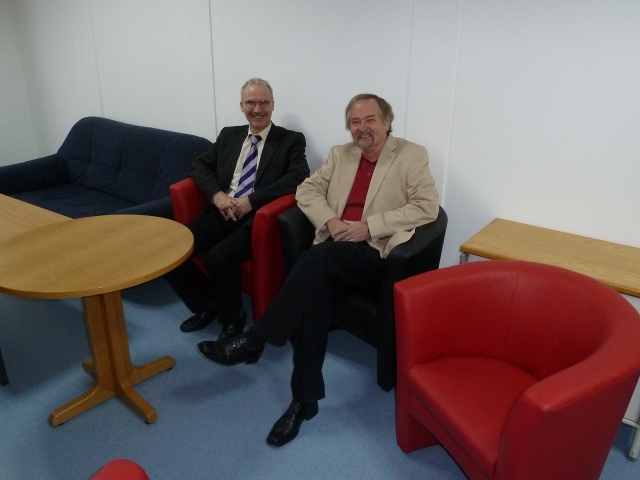
On January 19, the chancellor of the University, Dr. Reinhard Lutz, visited the new rooms of the Bethe Center, which the University significantly helped to fund. The picture shows him with bctp Director Hans Peter Nilles in one of the discussion areas on the corridor.
Particle Phenomenology Guests
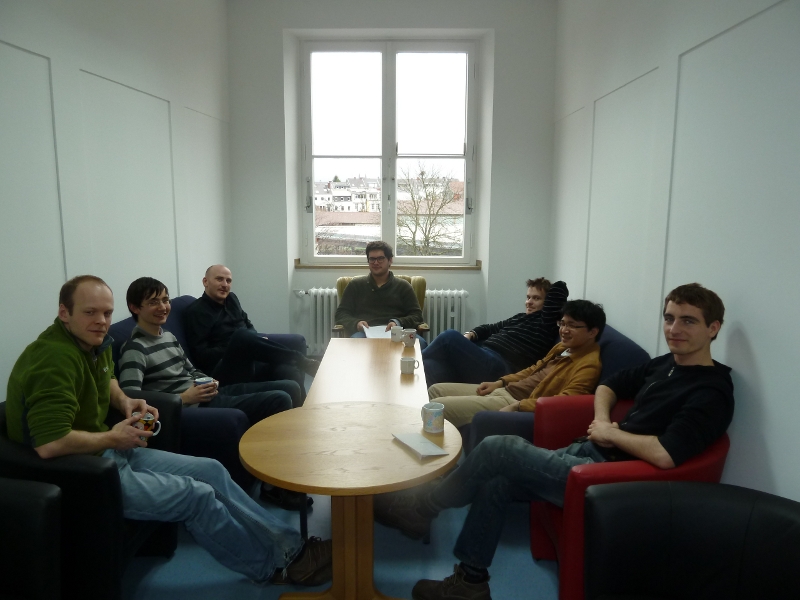
In the week from January 16 to 20, the bctp had three visitors working on particle phenomenology. In the pictrue, you can see Ben O'Leary and Eliel Camargo from Würzburg and Sho Iwamoto from Tokyo (third, fourth and sixth from the left) with Jamie Tattersall, Daniel Schmeier, Florian Staub and Kilian Nickel from the group of Professor Dreiner in one of the discussion areas.
ETMC Meeting
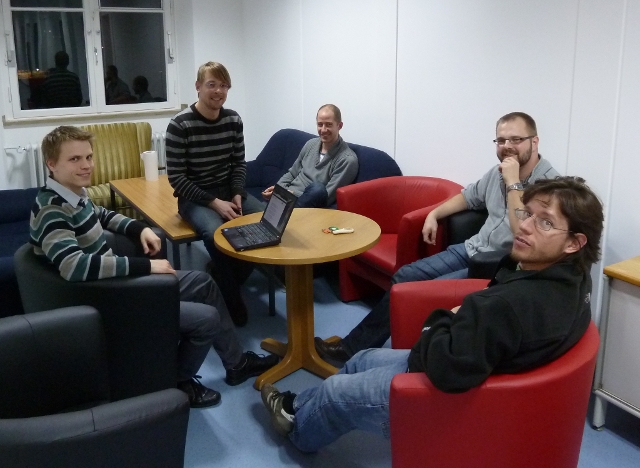
On January 12th and 13th the bctp hosted a meeting of the European Twisted Mass Collaboration (ETMC). The meeting was focused on discussing and developing a software suite for simulations in lattice quantum chrmonodynamics. The meeting had local and European participants, for instance from the Netherlands, Switzerland and Spain.
Visit of Prof. Ramos-Sánchez
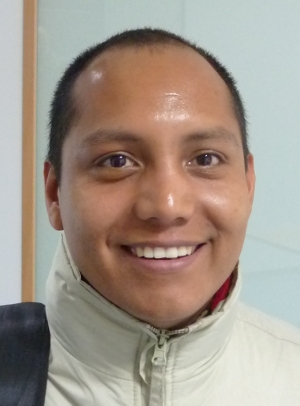
Saúl Ramos-Sánchez from the National University of Mexico (UNAM) visited the Bethe Center in January 2012. He received his Ph.D. in the group of Prof. Nilles in Bonn. His research interests focus on grand unified theories, supersymmetric models, supergravity and string theory.
Visit of Professor Jihn E. Kim
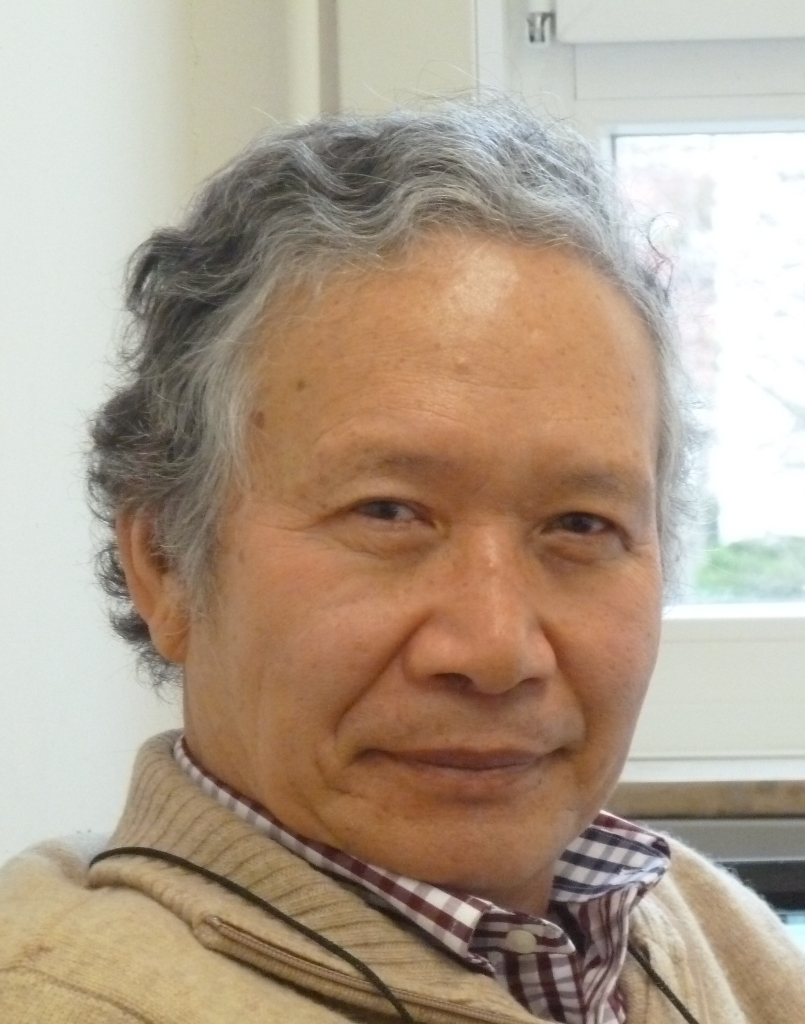
Humboldt research prize laureate Professor Jihn E. Kim from Seoul National University visited the Bethe Center from December 2011 to February 2012. He is a member of the Bethe Center advisory board and a frequent visitor to Bonn. Prof. Kim and Prof. Nilles enjoy a close collaboration for almost 30 years. Prof. Kim's research interests concentrate on particle physics and cosmology.
Bethe Colloquium by Prof. Harald Fritzsch
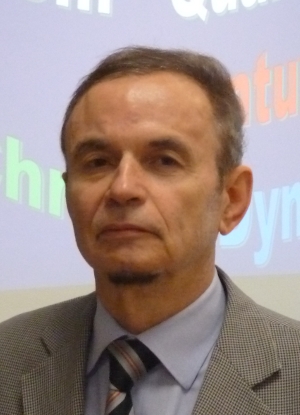
January's Bethe Colloquium took place on January 12 (3:15 pm) in Hörsaal I:
- Harald Fritzsch (LMU Munich)
- From Quarks to Chromodynamics
- Hörsaal I, Physikalisches Institut
Abstract: Today QCD is regarded as the correct theory of the strong interactions. In 1971 Gell-Mann and I introduced the color quantum number of the quarks, one year later the exact color symmetry group was interpreted as the gauge group of QCD. The self-coupling of the gluons leads to the property of asymptotic freedom and to the confinement of the quarks and gluons. The proton mass can be calculated, but the quark masses are free parameters. The quarks and gluons have been observed at high energies as hadronic jets.