

Past activities
« previous | page 5 of 7 | next »Merry Christmas from the bctp!
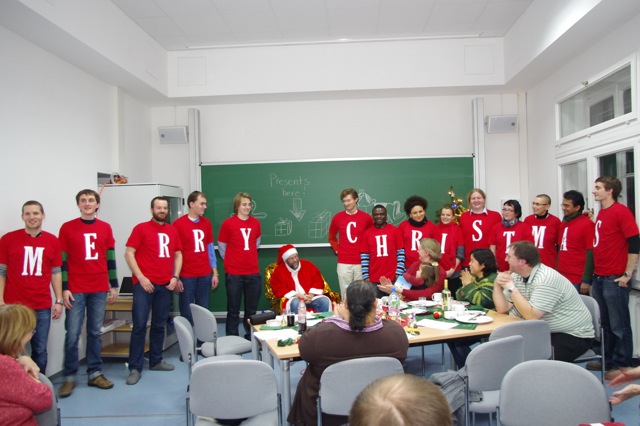
The Bethe Center wishes merry christmas and a happy new year. As you can see on the picture, Santa Claus (center, seated) visited the new bctp Seminar Rooms for a special presentation.
Bethe Colloquium by Prof. Manfred Lindner
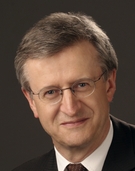
December's Bethe Colloquium took place on December 08 (3:15 pm) in Hörsaal I:
- Manfred Lindner (MPIK Heidelberg)
- Neutrinos as Probes of new Physics
- Hörsaal I, Physikalisches Institut
Abstract: Neutrino physics is in an exciting phase of dicovery which has given us very valuable results already. As rather special objects, neutrinos on the one hand allow important and unique insights into the fundamental properties of particle physics. One the other hand, they can be used as probes for a variety of sources, which gives interesting connections to current topics in astrophysics, cosmology, nuclear physics and geophysics. In the talk we will review the current state of the field and discuss recent results.
5th annual meeting of the Helmholtz-Alliance
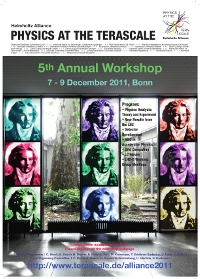
The Helmholtz Alliance "Physics at the Terascale" bundles German activities in the field of high-energy collider physics. It is a network comprising all German research institutes working on LHC experiments, a future linear collider or the related phenomenology - 18 universities, two Helmholtz Centres and one Max Planck Institute. The Alliance includes the following topics: development of new accelerator and detector technologies, methods of data analysis, development of theoretical models and methods and development of the relevant computing infrastructure.
bctp moves to Wegelerstraße
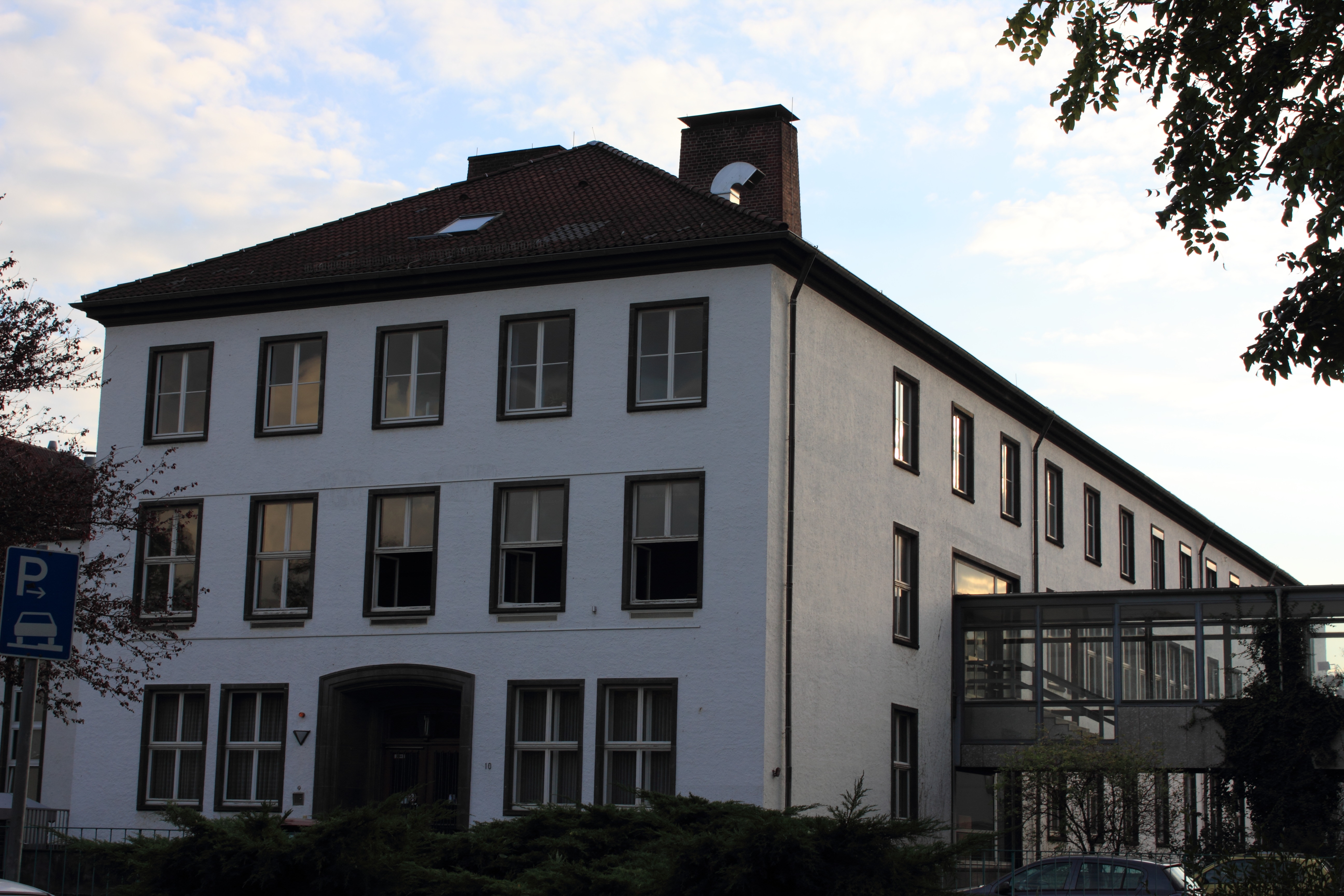
From October 19, the groups working on particle physics and string theory moved into the new bctp corridor on the top floor of the building Wegelerstraße 10. The new rooms include offices for students and postdocs and space for visitors (e.g. during the Bethe Forum) as well as seminar rooms. At the same time, the condensed matter theory groups have moved from the AVZ to the first floor of the PI.
Bethe Forum
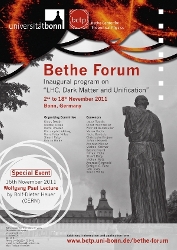
From November 2nd to November 18th, there will be the inaugural program of the Bethe Forum. Topics covered will be
- LHC and Collider Phenomenology
- Dark Matter
- Grand Unification
During the three weeks, experts will meet and discuss current topics in the above mentioned areas of physics. More information can be found on the program's homepage.
Bethe Colloquium by Prof. François Englert
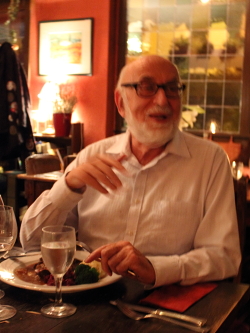
October's Bethe Colloquium took place on October 13 (3:15 pm):
- François Englert (Université Libre, Brussels)
- Broken Symmetry
- Hörsaal I, Physikalisches Institut
François Englert is one of the pioneers of spontaneous symmetry breaking in quantum field theory. The Brout–Englert–Higgs mechanism, suggested in 1964, proved to be the key to understand the masses of the W and Z bosons and opened the way to the unification of weak and electromagenetic interactions in the Standard Model. In this talk, Professor Englert will give a general discussion of broken symmetry, from its origin in phase transitions to its use in Yang–Mills theory, with particular emphasis on conceptual issues.
Bethe Colloquium by Prof. Volker Schomerus
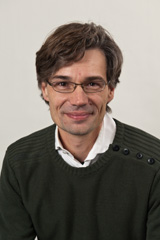
June's Bethe Colloquium took place on June 30 (3:15 pm):
- Volker Schomerus (DESY)
- Of Mesons and Metals - Bethe and the 5th Dimension
- Hörsaal I, Physikalisches Institut
Abstract: Quantum field theory is highly successful in explaining features of our world, yet still physicists often struggle to extract well-known phenomena such as e.g. observed meson resonances in particle physics, etc. Over the last decade, an intriguing geometric reformulation of 4-dimensional quantum systems has begun to emerge which involves strings in certain 5-dimensional curved backgrounds. The relevant concepts and methods of string geometry offer a powerful new approach to quantum physics. Remarkably, the foundations of classical string geometry were laid nearly a century ago; they may be traced back in particular to Hans Bethe's work on the theory of metals.
Podcast: The colloquium has been recorded by uni-bonn.tv – you can find the video here (see also the list of bctp podcasts).
PLANCK2011 and PeterFest in Lisbon
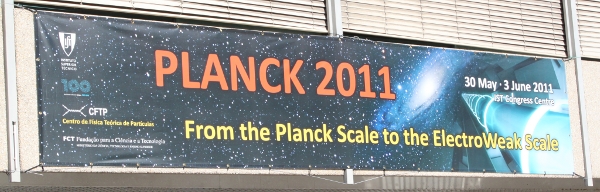
The annual conference PLANCK2011 "From the Planck Scale to the ElectroWeak Scale" is a joint enterprise of several European research groups in the framework of the Marie Curie ITN network "UNILHC". This year the PLANCK meeting was organized by the Lisbon node. On Thursday June 2nd the programme was dedicated to "PeterFest" in honour of Hans Peter Nilles. Some photos of the event can be found here.
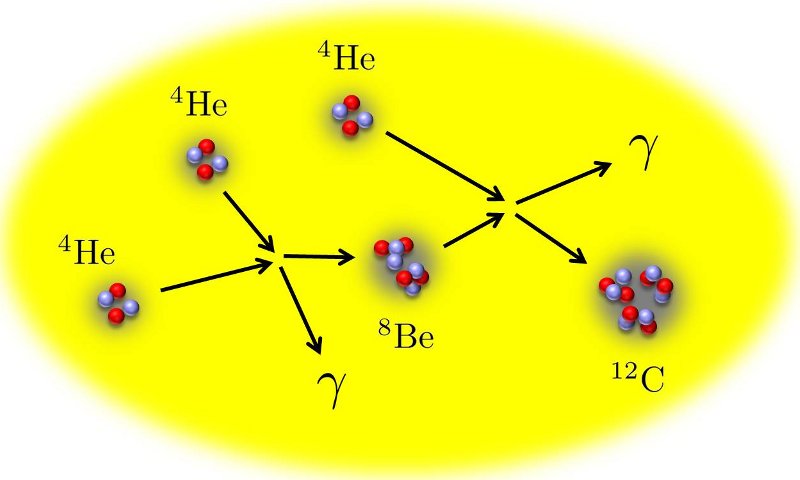
Calculation of the Hoyle state by Prof. Ulf Meißner
Bethe Colloquium by Prof. Gia Dvali
May's Bethe Colloquium took place on May 26 (3:15 pm):
- Gia Dvali (LMU Munich and CERN)
- Microphysics and Nature's Fundamental Length
- Hörsaal I, Physikalisches Institut
Abstract: We review an emerging underlying connection between microphysics and the fundamental shortest length-scale of nature. We discuss how the latter length is determined by seemingly unrelated properties of long-distance particle physics, such as number and symmetries of elementary particles. We review some phenomenological implications of this connection, such as physics of micro black holes that should be accessible whenever the fundamental length can be probed in collider experiments. We discuss how the existence of the minimal length sheds a very different light at the concept of ultra-violet completion, according to which, at very high energies physics of elementary particles becomes governed by classical dynamics.
Humboldt prize awarded to Prof. Howard Haber
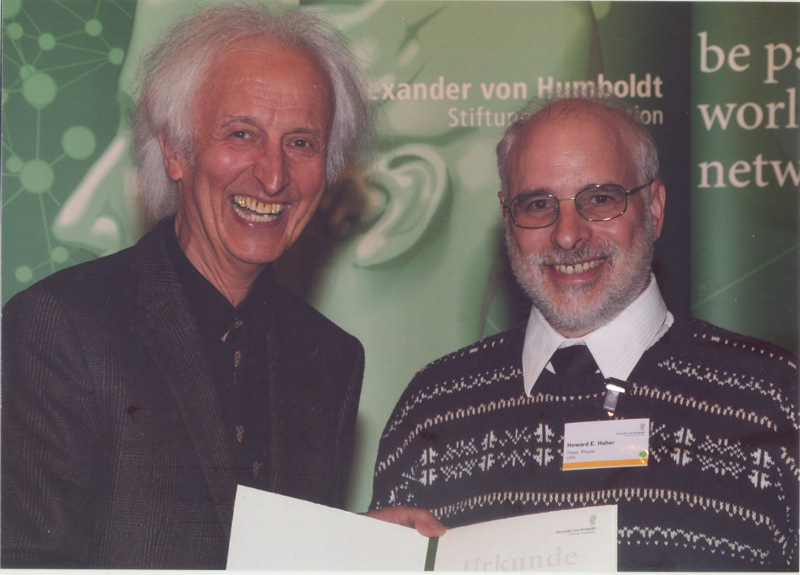
Humboldt prize laureate Prof. Howard Haber from the University of California, Santa Cruz, is spending his research visit at the Bethe Center as a guest of BCTP members Prof. Manuel Drees and Prof. Herbert Dreiner. The picture shows the president of the Humboldt foundation, Prof. Schwarz (left), who is presenting Prof. Haber (right) with the Humboldt prize during the ceremony at the annual Symposium for Research Awardees in Bamberg, on March 26th, 2011.
Bethe Colloquium by Prof. Mikhail Voloshin
April's Bethe Colloquium took place on April 07 (3:15 pm):
- Mikhail Voloshin (W. Fine Theoretical Physics Institute, University of Minnesota & ITEP, Moscow)
- Searches for a neutrino magnetic moment
- Hörsaal I, Physikalisches Institut
Abstract:The neutrino magnetic moments (NMM) predicted in the Standard Model are proportional to the neutrino masses and are very small. Thus an observation of significantly larger NMM would provide a direct access to a New Physics. I review some `new' models of a large NMM as well as the current astrophysical and direct experimental bounds. Modern searches for NMM using cryogenic Ge crystals exposed to the flux of (anti)neutrinos from a nuclear reactor have reached the sensitivity where atomic effects in neutrino-electron scattering require a theoretical analysis. I report on some recent theoretical developments in this interesting problem of atomic physics.
XXIII Workshop - Beyond the Standard Model
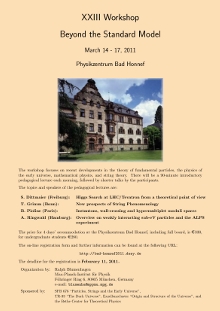
From March 14 to March 17, 2011 the yearly workshop "Beyond the Standard Model" took place at the Physikzentrum Bad Honnef. This workshop is dedicated to research topics reaching from particle physics and cosmology to string theory.
- S. Dittmaier (Freiburg): Higgs Search at LHC/Tevatron from a theoretical point of view
- T. Grimm (Bonn): New prospects of String Phenomenology
- B. Pioline (Paris): Instantons, wall-crossing and hypermultiplet moduli spaces
- A. Ringwald (Hamburg): Overview on weakly interacting sub-eV particles and the ALPS experiment
The workshop was organized by Prof. R. Blumenhagen.
3rd Bethe Center Workshop
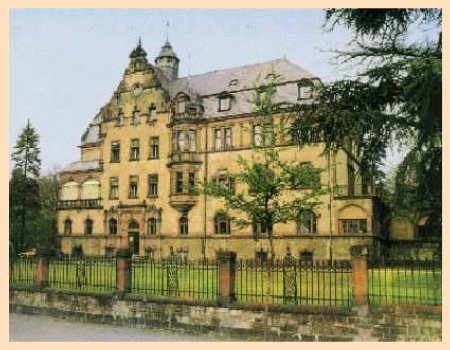
From February 12 to February 16, 2011 the 3rd Bethe workshop / 474th International Wilhelm und Else Heraeus Seminar took place at the Physikzentrum Bad Honnef. This workshop centered around Strong interactions: From methods to structures. Please go to the workshop page for more information.
Bethe Colloquium by Prof. Lance Dixon
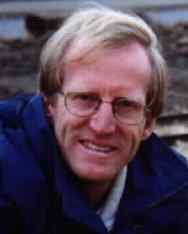
January's Bethe Colloquium took place on 13. January (3:15 pm):
- Lance Dixon (CERN & SLAC)
- New Tools for Forecasting Old Physics at the LHC
- Hörsaal I, Physikalisches Institut
Abstract: For the LHC to uncover many types of new physics, the "old physics" produced by the Standard Model must be understood very well. For decades, the central theoretical tool for this job was the Feynman diagram expansion. However, Feynman diagrams are just too slow, even on fast computers, to allow adequate precision for complicated LHC events with many jets in the final state. Such events are already visible in the initial LHC data. Over the past few years, alternative methods to Feynman diagrams have come to fruition. These new "on-shell" methods are based on the old principles of unitarity and factorization. They can be much more efficient because they exploit the underlying simplicity of scattering amplitudes, and recycle lower-loop information. I will describe how and why these methods work, and present some of the recent state-of-the-art results that have been obtained with them.