Anniversary
5 years bctp
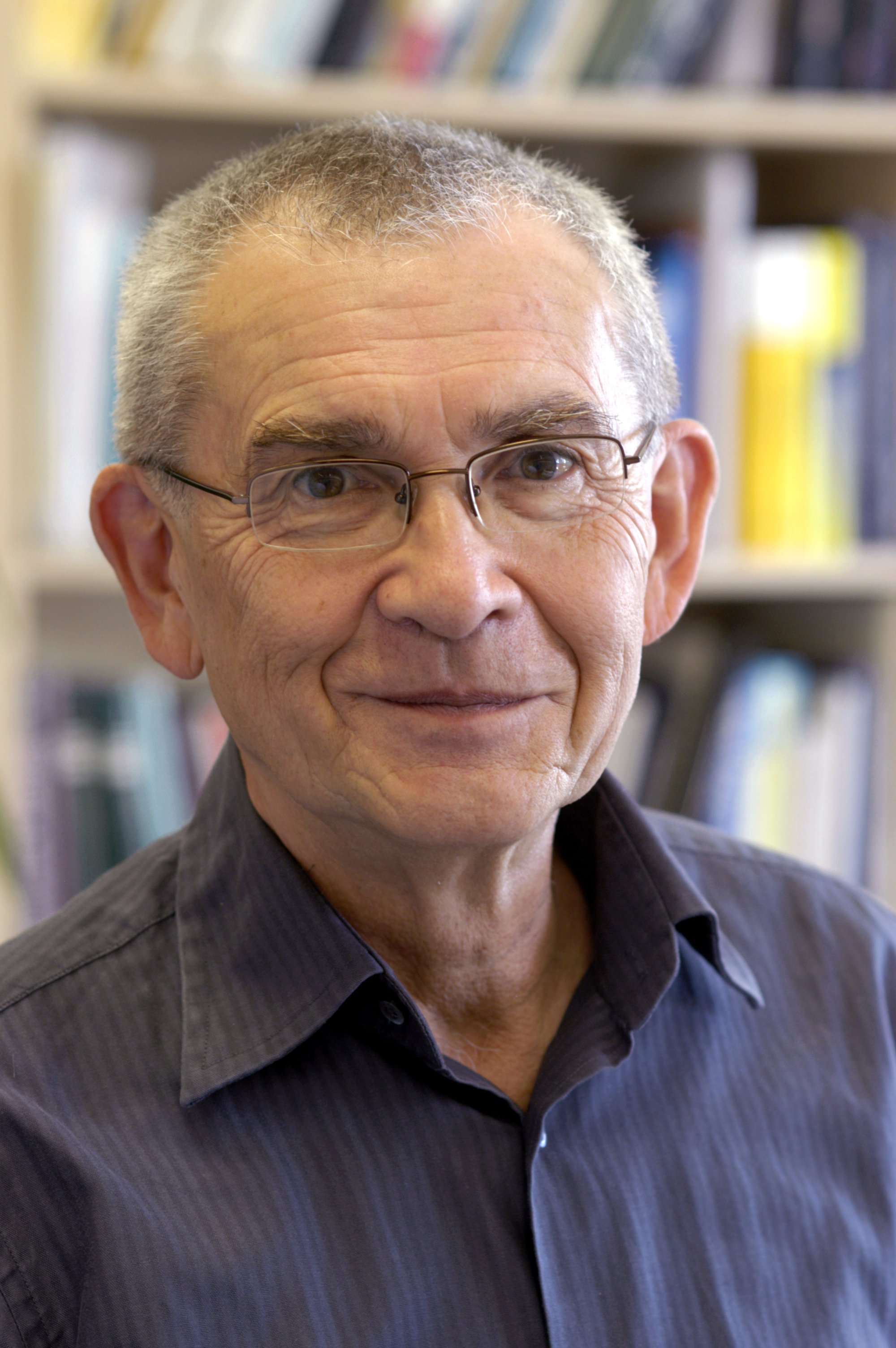
Yuri I. Manin, Bonn
"Big Bang, Blow Up, and Modular Curves: Algebraic Geometry in Cosmology" (joint with M. Marcolli)
Abstract
We introduce some algebraic geometric models in cosmology related to the "boundaries" of space-time: Big Bang, Mixmaster Universe, Penrose's crossovers between aeons. We suggest to model the kinematics of Big Bang using the algebraic geometric (or analytic) blow up of a point x. This creates a boundary which consists of the projective space of tangent directions to x and possibly of the light cone of x. We argue that time on the boundary undergoes the Wick rotation and becomes purely imaginary. The Mixmaster (Bianchi IX) model of the early history of the universe is neatly explained in this picture by postulating that the reverse Wick rotation follows a hyperbolic geodesic connecting imaginary time axis to the real one. Penrose's idea to see the Big Bang as a sign of crossover from "the end of previous aeon" of the expanding and cooling Universe to the "beginning of the next aeon" is interpreted as an identification of a natural boundary of Minkowski space at infinity with the Bing Bang boundary.CV
Yuri Manin is currently a professor at the Northwestern University in Evanston and at the Max-Planck-Institut for Mathematics in Bonn. He obtained his Ph.D. from the Steklov Mathematics Institute in Moscow under the supervision of Igor Shafarevich in 1960. Since 1993 he was a director of the Max-Planck-Institut for Mathematics in Bonn until he retired in 2005.Yuri is known for his work on number theory, algebraic geometry, diophantine geometry and mathematical physics. In the 1960s, he proved the Mordell conjecture in the function field case, studied algebraic surfaces over the field of rational numbers, and showed the role of the Brauer group in accounting for obstructions to the Hasse principle, setting off a generation of further work. He wrote an influential book on cubic surfaces and cubic forms, showing how to apply both classical and contemporary methods of algebraic geometry, as well as non-associative algebra. The Gauss--Manin connection --- a basic ingredient in the study of cohomology in families of algebraic varieites --- is named after him. Starting in the 1980s, Yuri got more and more interested in aspects of mathematical physics from an algebraic geometry point of view. He is well known for his works on Yang-Mills theory and instantons, string theory and mirror symmetry, and quantum information.
Yuri has received many honors and awards, among them the Moscow Mathematical Society Award in 1963, the Highest USSR National Prize (Lenin Prize) in 1967, the Brouwer Gold Medal from the Netherlands Royal Society and the Mathematical Society in 1987, the Nemmers Prize in Mathematics from the Northwestern University in 1994, the Schock Prize in Mathematics of the Swedish Royal Academy of Sciences in 1999, the Cantor Medal of the German Mathematical Society in 2002, and the Bolyai Prize of the Hungarian Academy of Sciences in 2010.